

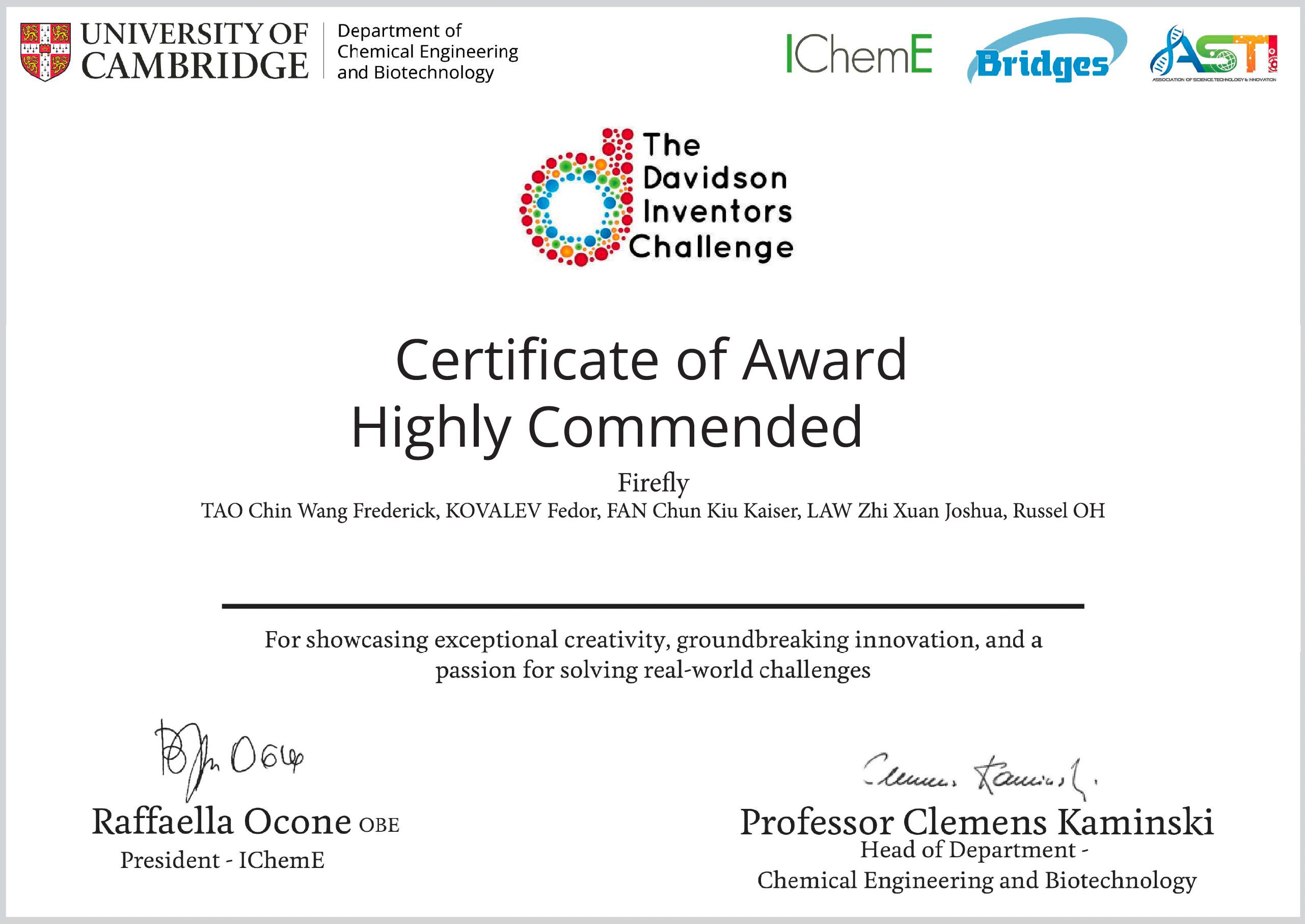
My classmates and I built a portable water tester that indicates if drinking water is safe within minutes and without the use of a laboratory or electrical outlets. Our project was awarded the title of ‘Highly Commended’ at the Davidson Inventors Challenge. This challenge, organized by the University of Cambridge’s Chemical Engineering and Biotechnology department, is in collaboration with the Institution of Chemical Engineers (IChemE).
Our certificate was signed by Professor Clemens Kaminski and Raffaella Ocone OBE. It describes the award as being given for "showcasing exceptional creativity, groundbreaking innovation, and a passion for solving real-world challenges." I have read that sentence at least twenty times. I hate it, appreciate it, and am grateful for it, all in roughly equal amounts.
This is the story of how we built it, and why. The problem we set out to solve isn't the kind of problem that gets solved easily, but we figured we should at least try.
Millions Live Without Safe Drinking Water
More than 2 billion individuals do not have safe drinking water. We researched and studied the statistics, and we were shocked to find that, in Sub-Saharan Africa, approximately 33% of the population rely on surface water that could be contaminated with waterborne pathogens.
The standard way to check if water is microbiologically safe is to culture a sample in a lab and measure how much grows. It's reliable but slow. One to three days, typically. If you are standing in front of a stream right now, wondering whether you can drink from it, three days is not a useful answer.
So we asked ourselves the question: could you build something that gives an answer in minutes, costs almost nothing, and runs on sunlight? It sounded slightly insane when we wrote it down. But that was the goal.
What we invented: the Firefly Hydrolyte
The solution was the device, the Firefly Hydrolyte, which is portable and completely reusable, and tests water for four parameters:
- Microbiological activity, via ATP-bioluminescence, which is the same chemistry that produces glowing light in fireflies. Since ATP is a biomolecule and exists in all living organisms, its detection is a rapid and reliable indicator of the presence of an organism in the water.
- pH, in case of chemical imbalance.
- Total Dissolved Solids (TDS), which is a quick measurement of dissolved ionic contamination.
- Temperature, which, as I’ll elaborate, is of more importance than it seems.
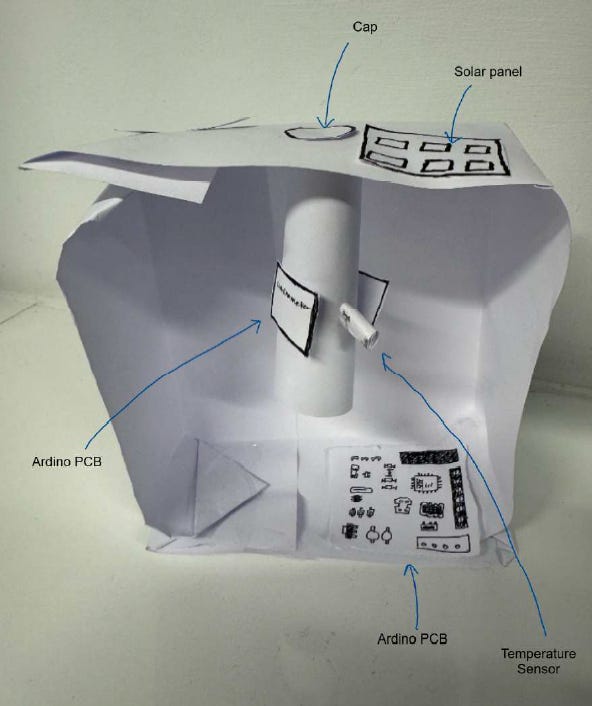
We made the output deliberately simple. A safety rating from 1 (unsafe) to 3 (safe), shown on a small screen. That wasn't the plan at first. Originally we had a much fancier interface with numbers, units, and graphs. Then we surveyed potential users, and almost every one of them said the same thing: just tell me if I can drink it. We overhauled the design around that.
The feature that I lost the most sleep over
My job on the team was to get the device to self-calibrate and run on solar power. It turned out to be the hardest part by some distance.
Here was the problem. The enzyme that makes the glow happen, luciferase, is fussy about temperature. The same water sample will produce different amounts of light depending on how warm the water is when you test it. If you don’t account for this, your readings are just wrong. And a water tester that gives wrong readings is genuinely worse than no tester at all, because at least with no tester, nobody is being lied to.
So I used published activity data to draw a curve relating luciferase activity to temperature. With that curve, you can take a raw light reading at any temperature, work out what fraction of peak activity the enzyme is running at, and back out what the reading would have been under standard conditions. We built that logic into the device. I also added a precaution: if the temperature or pH reading is unreasonable, the device throws an error rather than confidently making things up.
The same self-calibration logic applies to the hardware overall. The device doesn’t slowly drift out of accuracy, and doesn’t need a reference standard to stay reliable. It also runs on solar power, which means it can be used out in the field, where wall sockets tend to be in short supply.
One of the biggest lessons I learned came from the many attempts to get that curve right, not from the things that worked out on the first try.
Testing
This was not a "poster and pray" project. We built a working prototype around an Arduino, wired up the sensors, and tested it with real water samples.
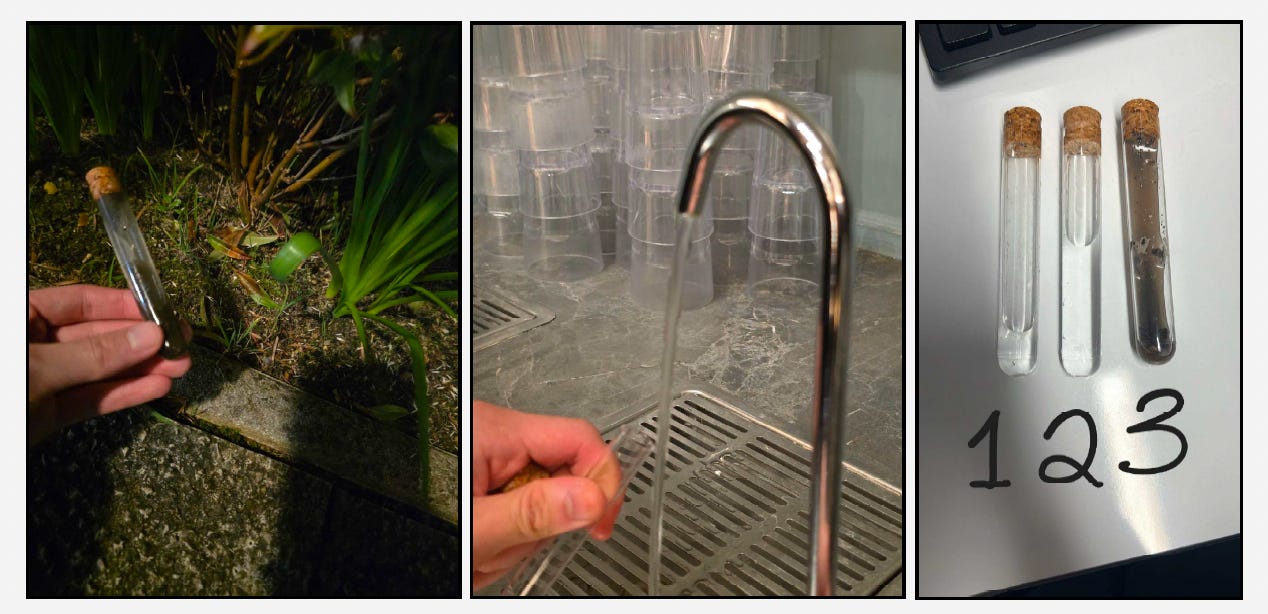
Below are our three test samples, in increasing order of how “dirty” we thought they were:
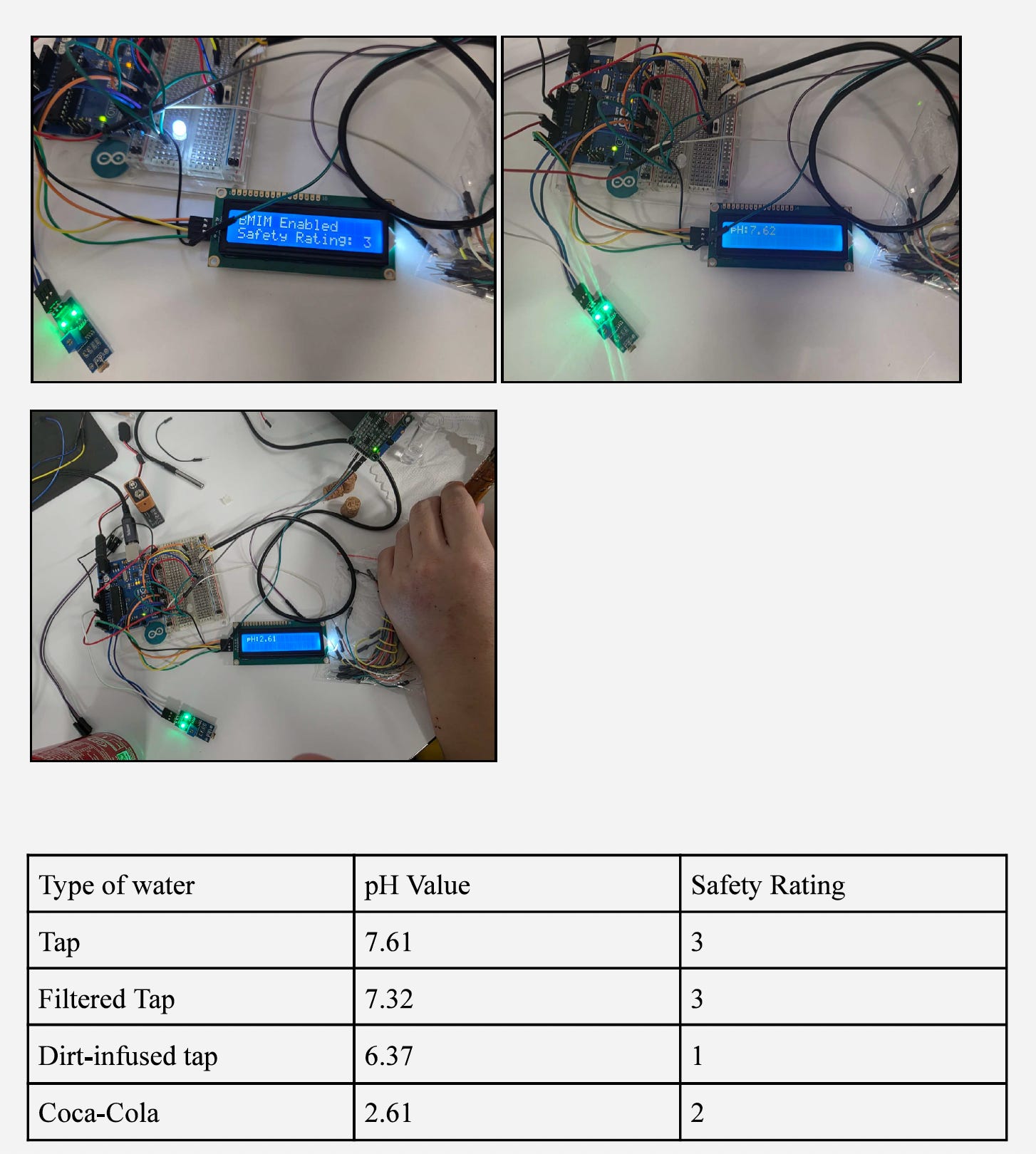
Filtered tap water was 87 mg/L (which is a safe drinking water level) and received a safety rating of 3.
Regular tap water measured at 303 mg/L.
As for the water with dirt, which measured at 838 mg/L, the device was right to flag it as a very serious issue.
We also compared pH across a few different solutions. For fun, we ran some Coca-Cola through the device, which came back at 2.61. That is exactly the pH of Coca-Cola, so the device passed its surprise audit. The results across the board matched what we expected, which was the first real evidence that the design actually worked.
What this taught me
The thing I'm proudest of, looking back, is that the whole process actually held together from start to finish. We started from a real problem, grounded it in the literature, looked at existing solutions and where they fall short, talked to actual potential users, designed around what they told us, built a prototype, tested it against controls, and refined it based on what came out. None of those steps got skipped, even the boring ones.
I honestly didn’t expect a school project to involve all of that. But I think this is how real engineering projects more or less go, and finishing one made me appreciate the profession quite a bit more, especially given that we wrapped this one up when I was sixteen, about to turn seventeen.
The UN’s Sustainable Development Goals 6 (Clean Water) and 12 (Responsible Consumption) were both on our minds when we designed the device. Being recognised as Highly Commended by Cambridge and IChemE mattered to us, not because of the award itself, but because it felt like a signal that the idea was worth building further.
Thanks for reading. More soon.